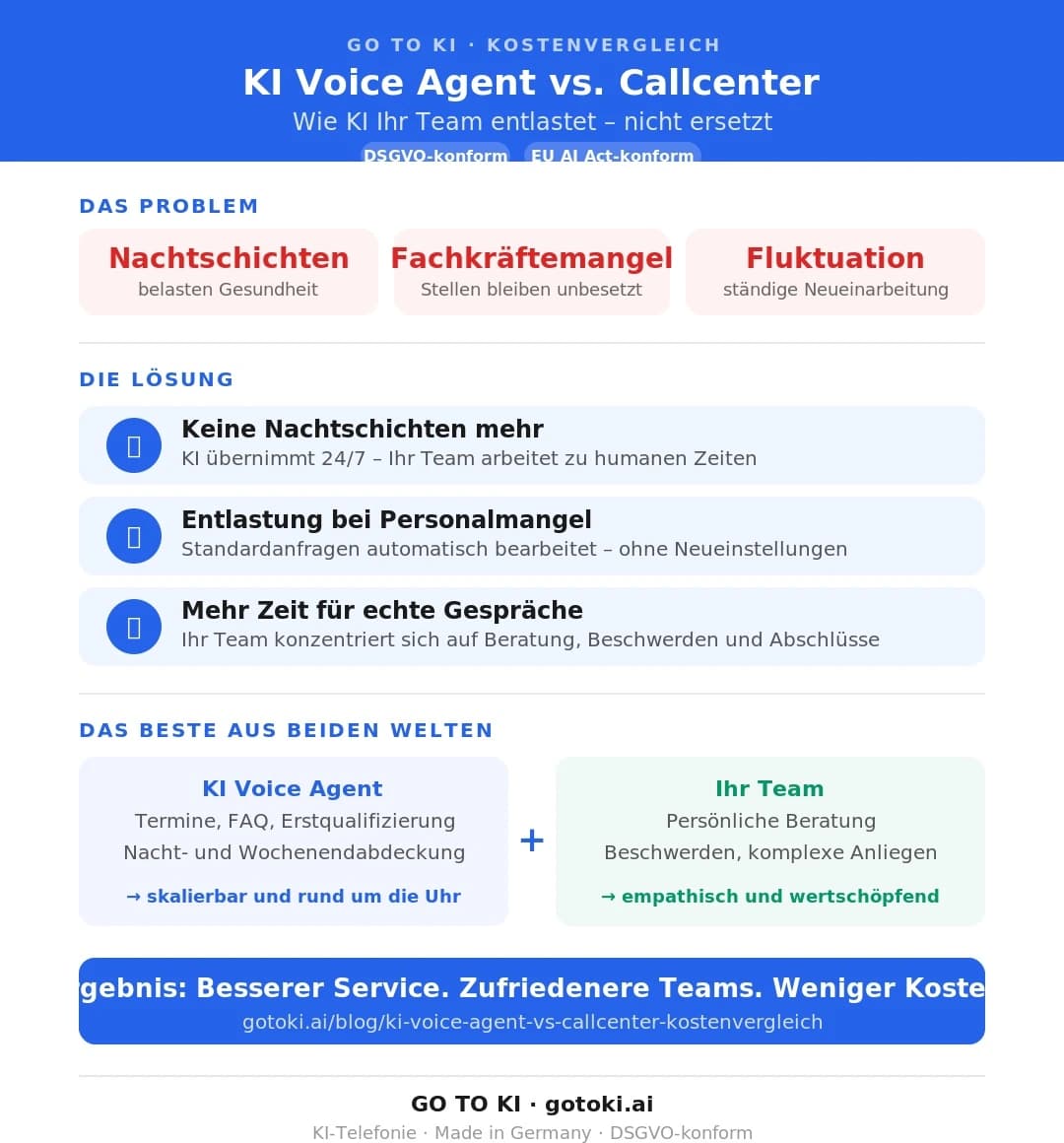
AI Voice Agent vs. Call Center: An Honest Cost Comparison
When companies aim to make their telephone service more efficient, a central question inevitably arises sooner or later: How do the costs of an AI Voice Agent actually compare to a call center? The answer is less straightforward than many providers suggest. Whether an AI telephone assistant is economically viable depends on factors such as call volume, complexity of inquiries, and existing IT infrastructure. This article provides decision-makers in SMEs, operations, or customer service with solid guidance.
What is an AI Voice Agent?
An AI Voice Agent is a software-based voice assistant that independently conducts phone conversations. Its foundations are technologies like automatic speech recognition, natural language processing, and modern large language models. Unlike traditional IVR systems, an AI Voice Agent understands free, natural speech.
What does a traditional call center really cost?
The costs of a traditional call center go far beyond the gross wages of individual employees. Personnel costs are indeed the largest item, but a genuine full-cost assessment includes much more: employer contributions to social insurance, costs for onboarding and ongoing training, as well as management overhead for team leadership and quality assurance.
What does an AI Voice Agent cost?
The market offers various pricing models. The usage-based model charges per conversation minute or per completed conversation. Monthly licenses or flat-rate models provide planning security for companies with constant volumes. In addition to ongoing costs, there are one-time setup and integration costs.
AI Voice Agent vs. Human Agent: The Direct Comparison
In terms of availability, the AI Voice Agent has a clear structural advantage: It is available 24/7, every day of the year, without shift surcharges. Regarding scalability, an AI Voice Agent can handle an unlimited number of conversations simultaneously. However, in complex situations, emotional matters, or complaints, human agents are clearly superior.
Hybrid Model: When AI and Humans Work Together
In practice, neither full adoption of AI nor exclusive operation of a traditional call center proves to be the optimal solution for most companies. The hybrid support model combines the strengths of both approaches. The AI Voice Agent handles standardized inquiries such as appointment bookings and status inquiries. Human professionals focus on complaint management and individual consulting.
When is an AI Voice Agent worthwhile for your company?
Whether an AI Voice Agent is economically viable can be assessed based on several key criteria. If your company processes a high call volume and a large portion of these calls are standardized inquiries, the savings potential is particularly high. Ultimately, the payback depends on the interplay of current personnel expenditure, the chosen pricing model, and the proportion of automatable conversations.
Data Protection and GDPR
For companies in Germany, GDPR compliance of an AI Voice Agent is not an optional feature but a central decision criterion. An EU-compliant data storage on servers within the European Union should be self-evident for every provider. Data processing agreements are legally mandatory and should be reviewed before concluding contracts.
Conclusion
The cost comparison between AI Voice Agent and call center shows: There is no one-size-fits-all answer, but clear decision criteria. AI Voice Agents offer structural cost advantages with a high degree of standardization and growing call volume. The hybrid model combines both strengths and proves economically convincing for many companies.