AI Sales Agent: How Sales Teams Save Measurable Time
An AI Sales Agent saves time in sales where manual routine tasks currently dominate the workday. Sales teams in the B2B sector know this pattern: A significant portion of daily work time is spent on data management, lead research, follow-up emails, and preparation for initial contacts instead of qualified sales conversations. This is where AI agents in sales come in. They take over repetitive tasks automatically, contextually, and across channels. This article provides a practical overview of the concrete time-saving potentials, shows application cases in the DACH market, and offers guidance for your decision on whether an AI Sales Agent is the right lever for your company.
What is an AI Sales Agent and how does it differ from traditional sales tools?
Before you can evaluate the time-saving potential of an AI Sales Agent, it is worth taking a clear look at its functionality. An AI Sales Agent is a software-based system that independently executes defined sales tasks. These include automated lead research, contact data enrichment, sending personalized outbound messages across multiple channels, and independently scheduling meetings in the sales team's calendar.
The crucial difference from traditional CRM systems and static automation tools lies in the way they work. Traditional tools operate rule-based: they execute predefined if-then sequences and require manual adjustments when conditions change. An AI agent, on the other hand, acts contextually. It analyzes available data, recognizes patterns, and makes independent decisions based on this.
In practice, this establishes a new role model: the AI SDR, or AI-powered Sales Development Representative. This concept describes the use of an AI agent as a digital addition to the human sales team.
Time Savings Through AI in Sales
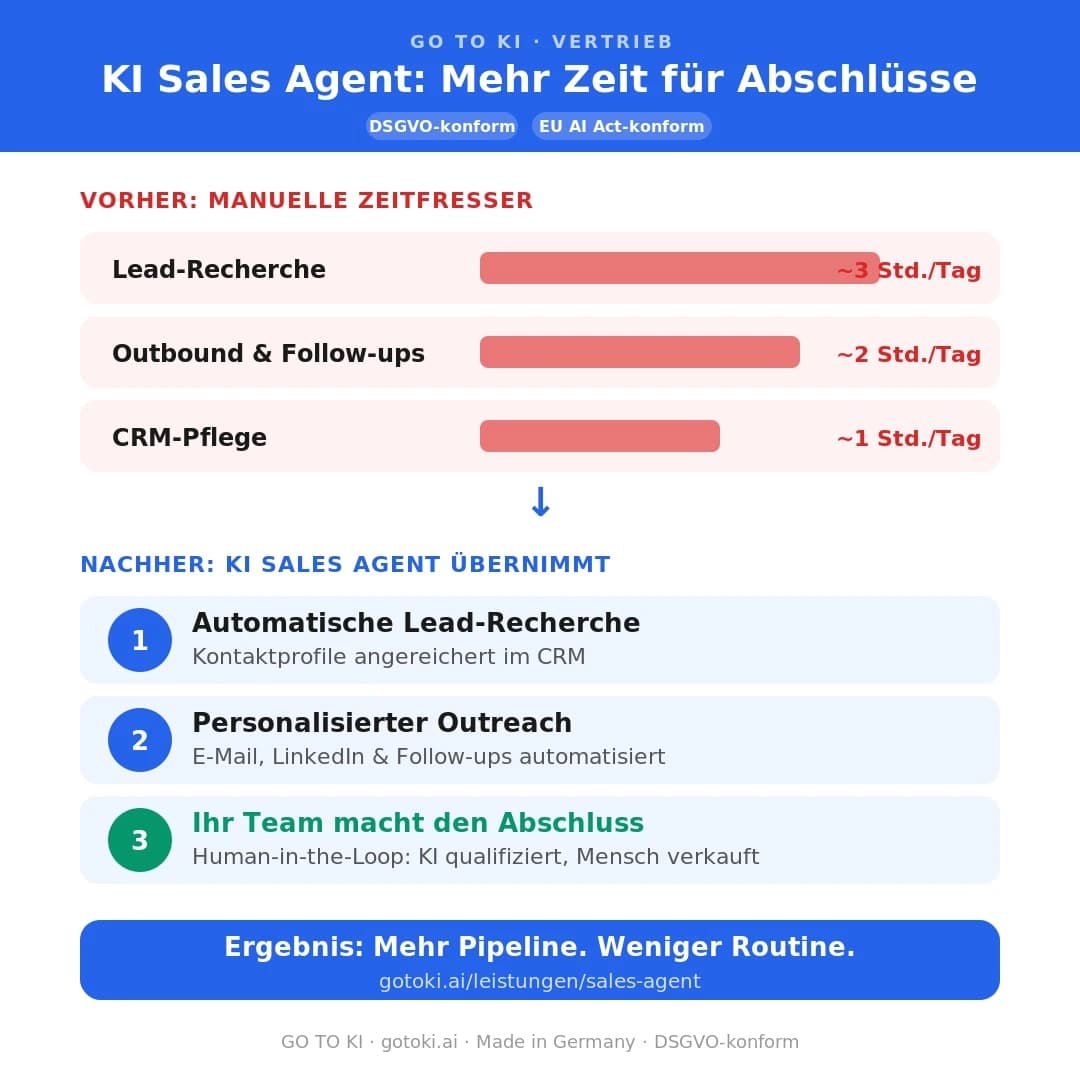
The question of actual time savings is central for many sales managers. The potentials are distributed across several clearly defined areas. The most time-consuming area in many sales organizations is manual lead research and data enrichment. An AI agent takes over this AI lead generation in B2B automatically, delivering enriched contact profiles directly into the sales funnel.
A second lever lies in the area of outbound communication. Crafting personalized initial emails and LinkedIn messages takes several minutes per contact. AI Sales Agents create these outreach sequences automatically and send them via configured multichannel workflows. Additionally, there is follow-up management. AI agents implement time-controlled follow-up sequences automatically and respond to answers contextually.
Application Cases in DACH Sales
The application possibilities of an AI Sales Agent are relevant across industries, but they show specific manifestations in the DACH market. Experts observe growing interest in outbound automation with AI in sales, especially in the B2B mid-market, SaaS sales, and industrial field sales.
A particularly relevant criterion for the DACH region is GDPR compliance. Sales teams in Germany, Austria, and Switzerland must ensure that tools used comply with data protection laws. This includes EU hosting, transparent data processing, and a reliable data processing agreement.
Integrating AI Sales Agent into Existing CRM Systems
The actual time savings of an AI Sales Agent largely depend on how seamlessly it integrates into existing systems. An AI CRM integration in sales is not an optional add-on, but a prerequisite for operational use. Without connection to the CRM, new media breaks occur: Data must be transferred manually, results get lost, and the workflow becomes fragmented instead of simplified.
Modern AI Sales Agents typically offer API interfaces or native integrations for common CRM systems. When selecting tools, a structured look at three key criteria is recommended: usability of the interface, integration ability with existing sales stacks, and data protection compliance according to GDPR requirements.
Is an AI Sales Agent Worth It?
The question of the ROI of an AI Sales Agent cannot be answered universally. An AI agent unfolds its greatest benefit where a relevant lead volume exists that can no longer be efficiently processed manually. If your sales team regularly conducts outbound activities but most time is spent on research and administration instead of conversations, there is clear potential for efficiency gains.
Not every sales task is suitable for fully automated operation. Especially with complex B2B sales cycles, human contact remains indispensable during the negotiation phase. The concept of Human-in-the-Loop describes exactly this interplay: The AI agent takes over scalable, repetitive tasks at the beginning of the funnel, while experienced salespeople focus on conversation-relevant discussions.
Conclusion
AI Sales Agents create measurable time savings in manual sales processes. They take on lead research, data enrichment, personalized outbound communication, and follow-up management automatically and across channels. This relieves sales teams where repetitive tasks consume the majority of work time and enables a scalable pipeline without proportional staff increases.