AI in the CRM process is changing the way companies build, maintain and grow customer relationships. Many CRM systems still rely on fragmented architectures in which data is spread across different tools and manual processes shape everyday work. As a result, sales and service teams spend a lot of time on administrative tasks instead of focusing on direct customer contact. This is exactly where artificial intelligence comes in: it automates recurring workflows, structures customer data in a meaningful way and creates the basis for well-founded decisions. For companies that want to make their processes future-proof, the question is therefore less whether AI will be used in CRM and more how to introduce it in a targeted and sustainable way.
What does AI in the CRM process mean in practice?
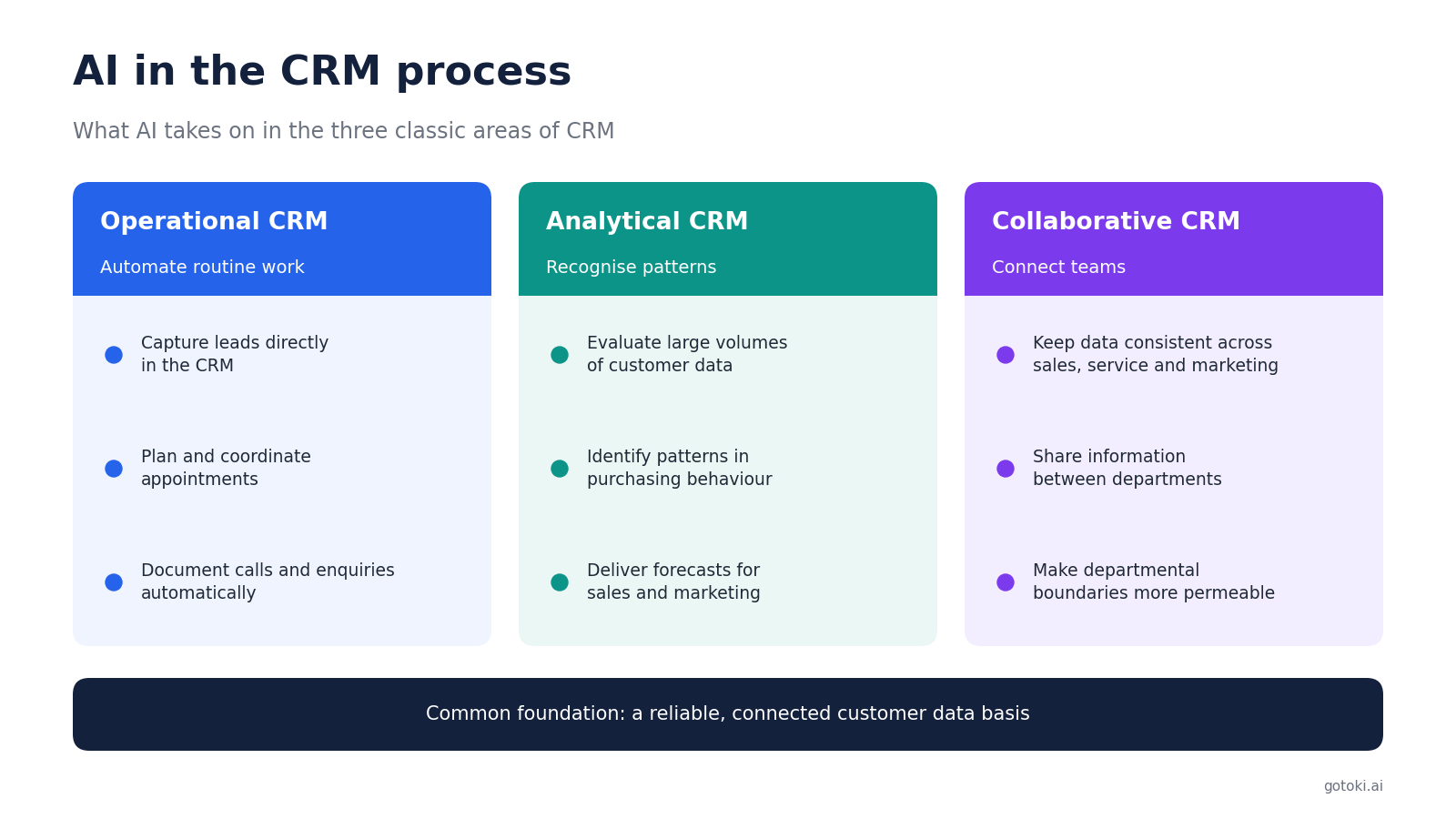
CRM with artificial intelligence describes the targeted integration of intelligent systems into existing customer relationship management structures. To understand the role of AI properly, it helps to look at the three classic areas of CRM: operational, analytical and collaborative. In operational CRM, AI mainly supports the automation of processes such as lead capture, scheduling and documentation. Analytical CRM offers particularly large potential: here, AI evaluates large volumes of customer data, identifies patterns in purchasing behaviour and delivers forecasts that would be almost impossible to produce manually. Collaborative CRM, in turn, benefits from AI keeping information consistent across sales, service and marketing, making the boundaries between departments more permeable.
Customer relationship management has always been about capturing and managing customer relationships systematically. What AI changes is the depth and speed of that management. Instead of simply storing data, CRM with artificial intelligence provides active support in day-to-day business, from automated recommendations to routine tasks carried out independently. This makes AI in the CRM process not an isolated add-on feature but a structural evolution of existing systems.
Use cases: where AI supports everyday CRM work
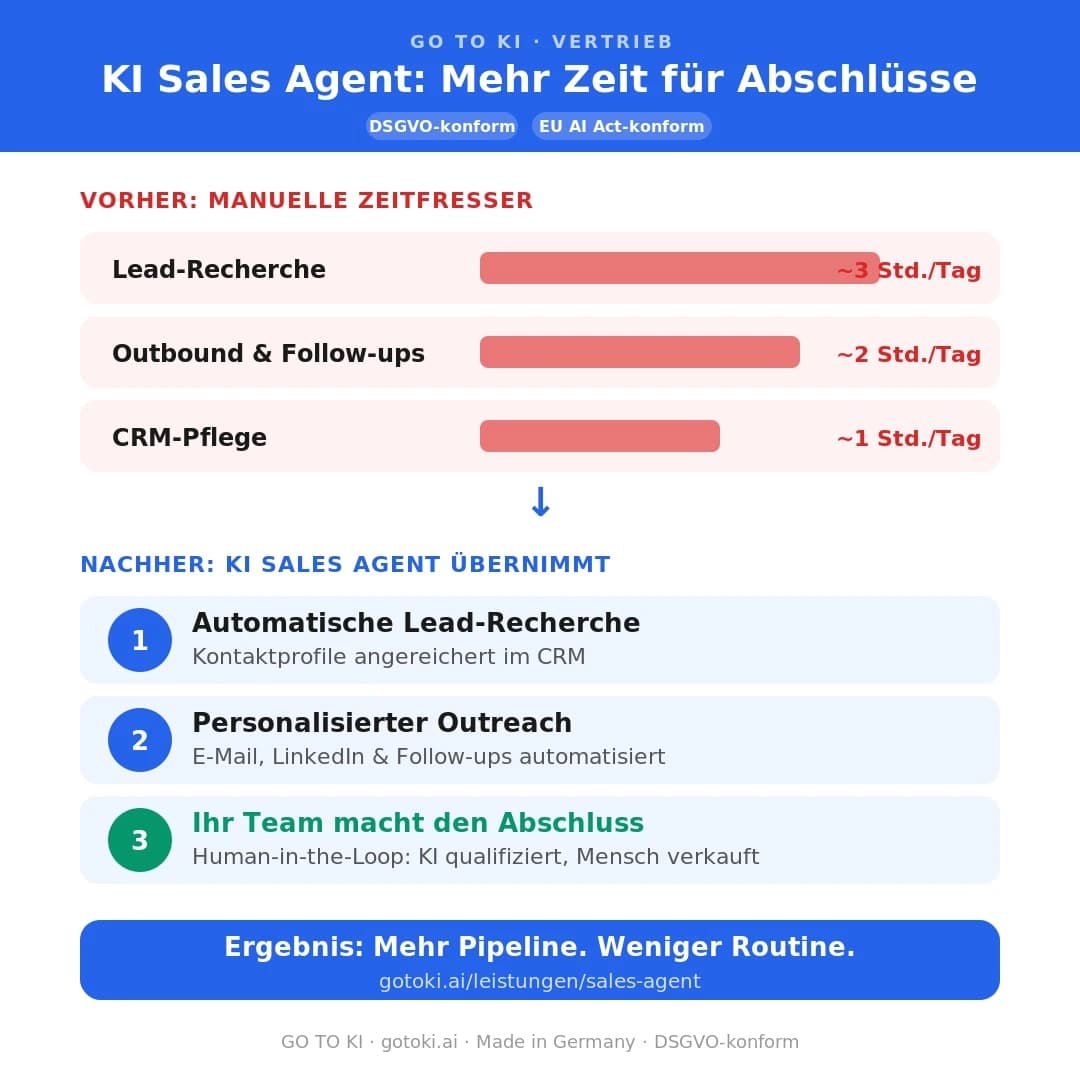
The use cases for AI in CRM are diverse and go well beyond simple automation. In sales, for example, an AI sales agent for your sales team captures new leads directly in the CRM system and ensures timely follow-ups without employees having to trigger every step manually. This reduces friction in the sales process and helps ensure that enquiries are handled promptly.
The added value of AI-supported CRM software is also clear in customer service. An AI service agent for customer service documents customer enquiries automatically and enters relevant information directly into the CRM. This creates a consistent data basis that all teams involved can access, without time-consuming manual follow-up work. Especially with recurring enquiries, this automation noticeably relieves the pressure of day-to-day business.
How AI sales agents save time in everyday sales becomes particularly clear with repetitive CRM tasks such as data maintenance, appointment coordination or lead prioritisation. AI-driven automation not only relieves individual process steps but also improves data quality across the entire CRM system.
Challenges when introducing AI-supported CRM systems
Despite the clear benefits, introducing an AI-supported CRM comes with typical challenges. A central problem is the fragmented architecture of many existing systems: customer data is often spread across different tools that have grown historically and are poorly connected. This fragmentation makes it harder to integrate AI functions meaningfully, because a reliable data basis is a prerequisite for any automation.
Data migration is another risk factor. When moving to a new or extended CRM system, existing customer data has to be cleaned, structured and transferred. Without careful planning, this can lead to data loss or inconsistencies. In addition, teams are often hesitant at first, because new tools and changed workflows initially feel like an extra burden. Where CRM projects fail, the cause is usually a combination of technical and organisational factors.
In highly fragmented CRM landscapes, custom AI system development can help connect existing structures in a meaningful way instead of replacing proven processes entirely. This makes it possible to optimise processes without companies having to rebuild their entire IT infrastructure from scratch. Planning for these challenges early significantly reduces the risk of a failed project.
Change management: why introducing AI in CRM is about more than technology
Technical implementation is only one part of a successful AI rollout in CRM. Change management is at least as important: employees need to understand why new processes are being introduced and have the opportunity to familiarise themselves with the changed workflows. Without this acceptance, even a technically mature solution remains unused or is only partly used.
A step-by-step rollout has proven effective in practice. Instead of switching all processes at once, companies first test individual use cases within a clearly defined scope and then expand them. Accompanying training ensures that teams can use the new tools confidently and that uncertainties are addressed early. Change management is not just about communication; it also means being willing to take on feedback from day-to-day business and adjust processes accordingly.
Individual AI consulting helps build change management in from the start rather than treating it as a later step. This makes the rollout viable not only technically but also organisationally, which is exactly what CRM with artificial intelligence needs to deliver its benefits.
Practical example: using AI successfully in customer contact
How AI proves itself in direct customer contact is best understood through concrete practical examples. In telephony, AI-supported systems capture incoming calls in a structured way, store relevant customer data automatically in the CRM and thus support complete documentation. This creates transparency within the team and a basis for better follow-up conversations.
The added value is particularly clear in car retail, where customer enquiries often come in by phone and quick responsiveness is essential. The practical example of AI telephony at a car dealership shows what this can look like in practice. It illustrates how customer contact can be scaled without compromising the quality of customer interactions. This is a key point for companies that want to grow without enlarging their service teams to the same extent.
Conclusion
AI in the CRM process gives companies the opportunity to make customer management more efficient, more data-driven and more scalable. At the same time, the challenges described, from fragmented architectures and data migration to acceptance within the team, show that technical solutions alone are not enough. Only the combination of sound consulting, well-thought-out implementation and accompanying change management makes AI-supported CRM projects successful in the long term. You can find an overview of suitable approaches for your CRM process in our AI solutions at a glance. Contact us for more information and get individual advice.
Frequently asked questions
What is meant by AI in the CRM process?
AI in the CRM process refers to the use of intelligent systems within customer relationship management solutions to partly or fully automate tasks such as data maintenance, lead qualification or customer communication. The aim is to reduce manual effort while improving the quality of customer data.
What are the benefits of AI in analytical CRM?
AI in analytical CRM makes it possible to evaluate large volumes of customer data and derive usable insights from them. These include patterns in purchasing behaviour or forecasts of customer development, which create a more solid basis for decisions in sales and marketing.
How does AI change the introduction of CRM systems?
Introducing an AI-supported CRM requires careful preparation, especially for data migration and integration into existing, often fragmented architectures. Companies should plan for these aspects early to reduce risks during the rollout.
What role does change management play in AI-supported CRM projects?
Change management is crucial so that employees accept new processes and actively use them. A step-by-step rollout, accompanying training and open communication contribute significantly to technical solutions actually taking hold in everyday work.
What concrete use cases are there for AI in CRM?
Key use cases include automated lead capture, AI-supported follow-ups in sales, documentation of customer service enquiries and automatic maintenance of customer data. These applications noticeably relieve teams of recurring tasks.