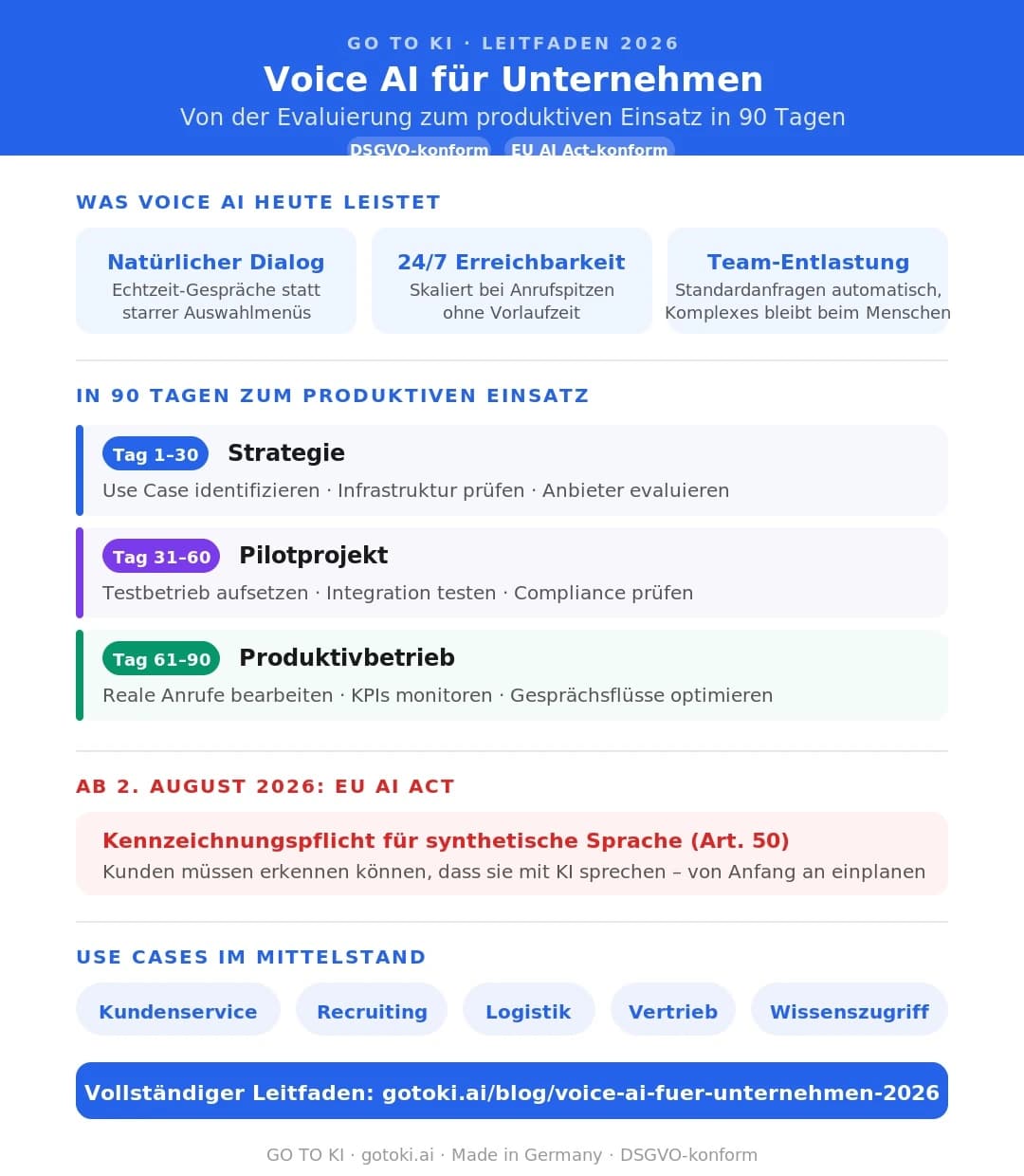
Implementing Voice AI in 2026 is no longer an innovation project but a strategic investment decision. Voice AI for businesses in 2026 means deployable voice agents that take on productive tasks in daily operations—from automated call handling to internal process support. While corporations are already scaling, many mid-sized companies face the challenge of how to structure and economically implement their entry. This guide provides answers. What can Voice AI really do today? Which concrete steps lead to productive implementation? And what regulatory requirements—especially by the EU AI Act—should you consider now?
What Voice AI Really Achieves in Companies in 2026
Voice AI has evolved from simple voice-controlled systems to an independent infrastructure category. The difference from older solutions is fundamental: While traditional interactive voice response systems relied on rigid rule sets and predefined menu structures, modern AI voice agents work with large language models and real-time processing. The result is natural, context-based conversations in real time—no rigid selection menu, but an actual dialogue.
AI voice agents today take on tasks that were previously handled exclusively by employees. In the contact center, they handle inbound calls, qualify inquiries, and direct complex issues to specialists. Appointment scheduling, status inquiries, and the initial handling of customer concerns are among the most common productive use cases. Conversational AI is not limited to customer service: Internal processes like querying knowledge databases or documentation via voice also benefit from the technology.
Critical impact is observed on two key business metrics: accessibility and service quality. An AI voice agent is available around the clock, scales during peak call times without lead time, and consistently handles standard concerns. This relieves existing teams and creates capacity for more demanding tasks.
Use Cases and Applications for Mid-Sized Businesses
For German mid-sized businesses, the primary lever of Voice AI customer service automation is within the contact center. Many companies struggle with high inbound volumes, long wait times, and limited accessibility outside business hours. AI voice agents resolve these bottlenecks: They take calls, answer recurring questions, record concerns in a structured way, and, if necessary, transfer to human representatives. Accessibility increases to 24/7—without additional personnel capacity.
Beyond customer service, use cases increasingly arise in other business areas. In HR, Voice AI handles initial contact with applicants, answers questions about the application process, and schedules interviews. In logistics, voice agents enable status inquiries about deliveries and delivery confirmations via phone. Access to internal knowledge databases via voice interaction is gaining importance: Employees obtain answers to operational questions without having to search manuals or intranet pages. The range of Voice AI use cases in Germany in 2026 shows that the technology is not limited to one industry or department but is effective wherever repetitive voice communication can be consolidated.
Costs, ROI, and Economic Evaluation of Voice AI Implementation
The question of economic viability is at the center of every Voice AI implementation decision. The cost factors can be divided into three areas: firstly, the license or API costs for the underlying language model, secondly, the integration effort for connecting to existing systems like CRM, telephony infrastructure, or ERP, and thirdly, the ongoing operating costs for monitoring, optimization, and maintenance. The height of these costs varies significantly—depending on the provider, complexity, and call volume.
For Voice AI ROI calculation in the company, current market data provides a framework. Gartner forecasts around USD 80 billion in savings worldwide in contact center personnel costs by 2026 through conversational AI. The Forrester Wave Q2 2026 measures the share of inbound volume covered by Voice AI in contact centers at around 19 percent, compared to 6 percent in 2024. This data indicates that the technology has become widespread.
A simplified example illustrates the mechanics: If a company receives 5,000 inbound calls monthly and an AI voice agent processes a relevant portion independently, the need for manual processing decreases accordingly. The resulting cost savings—lower personnel costs per processed call with simultaneously higher accessibility—can offset the implementation effort within a few months. However, concrete results vary by company. For a reliable ROI assessment, we recommend individual consulting that takes into account your specific conditions.
EU AI Act and Labeling Requirement—What Companies Must Consider from 2026
With the EU AI Act coming into force on August 2, 2026, a regulatory requirement directly impacting every Voice AI implementation in customer contact will apply. Article 50 of the EU AI Act compels providers and operators of AI systems to label synthetic audio content. This means that if your company uses an AI voice agent to call customers, those individuals must be able to recognize that they are speaking with an AI system and not a human.
The EU AI Act Voice AI labeling requirement goes beyond a mere formality. Article 50 demands transparency in the generation and dissemination of synthetic speech. Users have the right to know whether the voice on the other end is generated by a machine. The labeling must therefore be designed to be clear and understandable. Companies not adhering to this duty risk sanctions, which can be based on revenue.
Furthermore, the regulation addresses a growing risk: deepfake audio. The quality of synthetic voices has reached a level where human conversation partners can hardly recognize the difference. Responsible handling of this technology is therefore not only a compliance requirement but also a matter of trust. The recommendation is: Integrate the labeling early in the implementation phase—as a fixed part of your AI voice agent's conversation opening. Evaluate your Voice AI solution early for compliance with the requirements of the EU AI Act, and, if in doubt, consult legal experts. This article does not replace legal advice.
Implementing Voice AI in 90 Days—A Framework for Mid-Sized Businesses
A successful AI voice agent implementation in mid-sized businesses does not require years of project time but does require a structured approach. The following 30-60-90-day framework provides a realistic orientation—not a guaranteed timeline but a practice-proven structure you can adapt to your circumstances.
In phase 1, the first 30 days focus on strategic groundwork. You identify the use case with the highest automation potential—often the handling of incoming call inquiries in customer service. A parallel assessment of existing infrastructure follows: Which telephony and CRM systems are in use? What interfaces are available? In this phase, you define measurable success criteria and evaluate potential providers based on criteria like voice quality, latency, data protection compliance, and integration capability.
Phase 2, spanning days 31 to 60, focuses on the pilot project. You set up a limited test operation, for example, for a specific call category or defined timeframe. Technical integration is achieved through API connection to your existing systems. Internal test runs check conversation quality, recognition accuracy, and transfer processes to human specialists. At the same time, you conduct a compliance review according to the requirements of the EU AI Act and ensure adherence to the labeling requirement for synthetic speech.
In phase 3, days 61 to 90, you transition to productive operation. The AI voice agent now processes actual calls. Continuous monitoring captures key KPIs, such as the completion rate of automated conversations, customer satisfaction, and transition rate to the team. Based on this data, you optimize conversation flows, response quality, and escalation logic. Equally important is clear communication with your employees. Voice AI complements existing competencies; it does not replace them.
Conclusion—Strategically Approaching Voice AI Implementation in 2026
Voice AI for businesses in 2026 is no longer a future technology but a ready-to-use solution that automates processes, optimizes costs, and structurally improves accessibility in customer service. At the same time, successful implementation requires clear goal setting, careful provider selection, and early consideration of regulatory requirements such as the EU AI Act's labeling obligation. Mid-sized businesses particularly benefit when the introduction is gradual—with measurable results instead of oversized large-scale projects.