AI Voice Agent – Functionality, Technology, and Applications
How does an AI Voice Agent work technically? Learn about the technologies behind it – and how businesses benefit.
Text: AI-generated. Image: AI-generated.
Telephone communication is a daily routine for many companies, and this is where a growing problem arises. Calls go unanswered, employees are overwhelmed, and potential customers turn to competitors. Small and medium-sized enterprises, in particular, face the challenge of ensuring telephone accessibility with limited resources. The AI Voice Agent offers a technological answer to this situation. But how exactly does such an automatic telephone assistant with AI work? In this article, you'll learn about the technologies behind an AI Voice Agent, how individual processing steps work, and the scenarios in which companies can benefit from this solution. Whether you're getting to know the technology for the first time or are planning an introduction, here you will find the foundations for a well-informed decision.
What is an AI Voice Agent?
An AI Voice Agent is an AI-powered voice assistant for businesses that can conduct phone conversations independently. Unlike traditional IVR systems, where callers have to navigate through rigid menus using keypad entries, an AI Voice Agent understands natural language and responds contextually. The result is a real dialogue – not pre-recorded announcements, but a dynamic conversation in real time.
The distinction from well-known voice assistants like Siri or Alexa is essential. These are designed for general consumer inquiries and work without specific business knowledge. An AI Voice Agent, on the other hand, is focused on business communication. It knows your products, processes, and target audience. By integrating with company systems, it can schedule appointments, qualify inquiries, or provide information – all within the framework of a naturally sounding telephone conversation.
Technologically, such an agent is based on Conversational AI – a combination of speech recognition, intent recognition, and modern language models. These models allow the Voice Agent not only to recognize individual words but to understand the context and intent behind a statement. The foundation of this dialogue ability is known as Large Language Models – find out more in our article on Foundations of Large Language Models (LLMs).
How does an AI Voice Agent work technically? – The Step-by-Step Pipeline
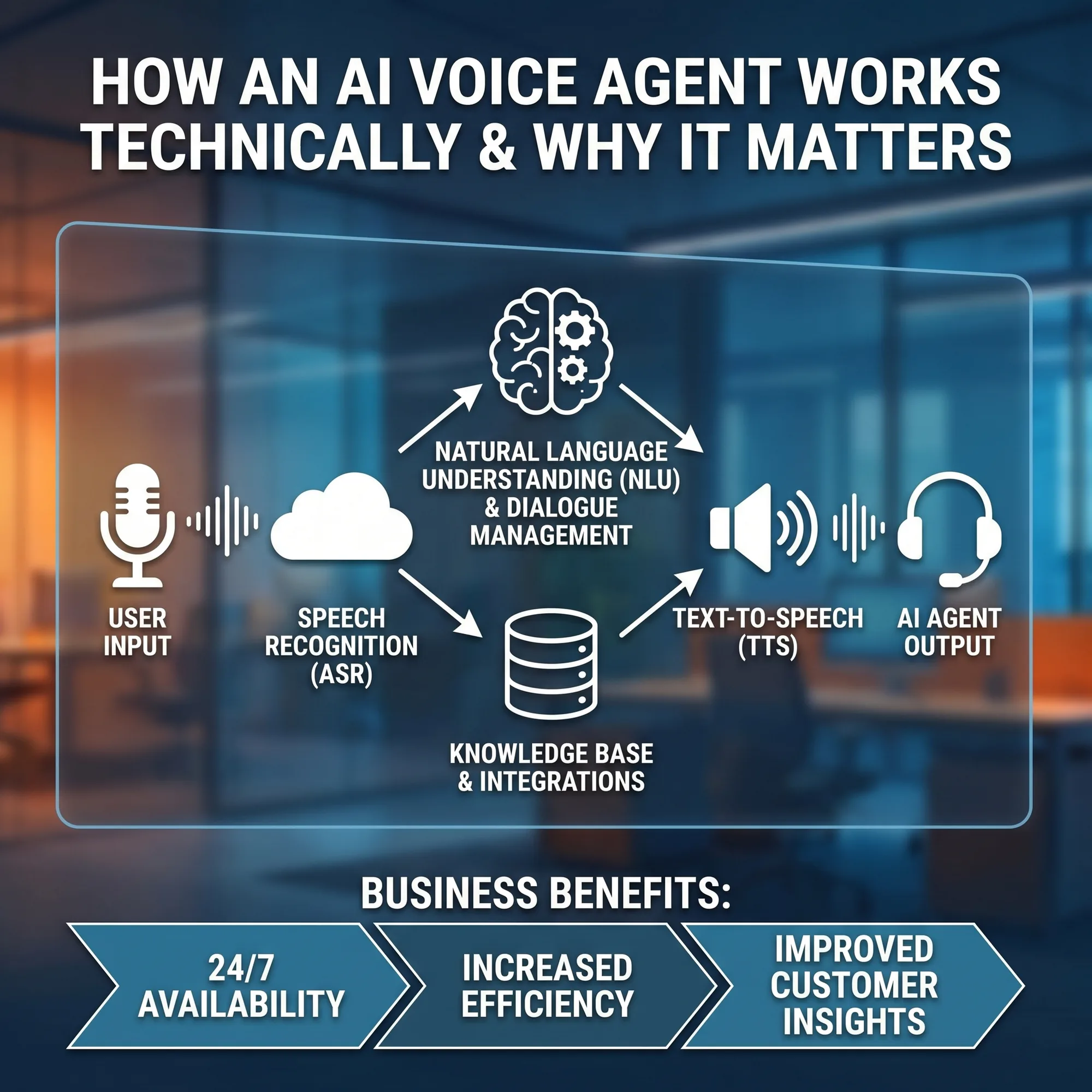
The functioning of an AI telephone assistant can be described as a pipeline where several technologies work seamlessly together. Each call goes through five consecutive processing steps, which run in real time, providing the other party with a natural conversational experience.
The first step is voice input via Automatic Speech Recognition, or ASR. The spoken words of the caller are converted into text in real time. Modern speech-to-text models can reliably process various dialects, speaking speeds, and background noise. The quality of this speech recognition is crucial for all subsequent steps.
This is followed by language understanding, also known as Natural Language Understanding or NLU. The generated text is analyzed to recognize the intent – the so-called intent – of the caller. At the same time, relevant information is extracted, such as a desired appointment time, a product name, or a customer number. This Natural Language Processing forms the bridge between spoken language and machine processing.
In the third step, dialog management takes over. Here, AI-based logic decides which action follows the recognized intent. This can be a direct answer, an appointment booking, forwarding to a responsible person, or asking for missing information. This dialog management ensures that the conversation proceeds in a structured and goal-oriented manner – comparable to an experienced receptionist.
Subsequently, a Large Language Model generates the appropriate response. Unlike predefined text blocks, the language model formulates a context-appropriate, naturally sounding reaction. It takes into account the previous conversation flow, the recognized concern, and the stored company information. This creates a response that doesn't feel mechanical but follows the flow of conversation.
In the final step, the generated text response is converted into spoken language by text-to-speech technology and delivered to the caller. Modern TTS systems produce speech output that closely resembles a human conversation in tone and speech rhythm. This entire process – from voice input to speech output – takes place within seconds and repeats with each round of conversation. In simple terms, Voice Agent technology is a combination of speech recognition, language processing, intelligent decision logic, and natural speech synthesis.
Application Areas: Where AI Voice Agents Help Companies
The applications of an AI Voice Agent are diverse, especially for businesses where the phone is a central communication channel. A common use case is the automatic call reception outside business hours. Instead of a voicemail, the Voice Agent takes the call, captures the request, and documents it for follow-up. This way, no inquiry is lost.
AI-supported appointment scheduling is also proving effective. The Voice Agent checks available time slots with a connected calendar, suggests suitable appointments, and confirms them – all without manual effort. For companies with a high volume of appointments, this means significant relief for employees on the phone.
Additionally, AI Voice Agents are suitable for the initial qualification of incoming inquiries. The system categorizes requests, captures relevant contact information, and schedules a return call with a specialist if needed. Providing answers to frequently asked questions – such as opening hours, availability, or service scope – can also be reliably automated. Targeted forwarding to the appropriate departments rounds out the performance spectrum in customer communication.
An example of this in practice is the use of a KI Voice Agent at Car Dealership König – a phone-intensive industry with high automation potential. KI telephony for small businesses is no longer a niche topic but a proven solution for crafts, healthcare, real estate industry, and many other areas. Find out about other applications of AI in business in our overview of AI applications in marketing and sales.
Advantages Over Classical Telephone Solutions – What Voice Agents Can Do
Compared to classical telephone systems, IVR systems, and manually staffed phone workplaces, AI Voice Agents offer several specific advantages. The most obvious one: 24/7 availability. An AI Voice Agent answers calls around the clock – regardless of business hours, holidays, or staff shortages. For your clients, this means being able to reach a competent contact person anytime.
Another factor is scalability. While a phone workplace can only handle one conversation at a time, a Voice Agent can conduct multiple conversations simultaneously. This makes the technology a reliable solution, especially during peak times or seasonal inquiry spikes. At the same time, call automation through AI ensures consistent communication quality. Every caller receives the same attention and care – unaffected by daily form, stress, or staff shortages.
The integration capability of modern Voice Agents is another plus point. Through API interfaces, they can be linked to existing CRM systems, calendar tools, or ticket solutions. This way, call data is directly integrated into your existing workflow automation, without the need for manual information transfer. In many scenarios, an automatic telephone assistant with AI also proves to be economically advantageous. Compared to permanently staffed phone workplaces, ongoing costs can be lower – though the exact KI Voice Agent costs depend on scope, configuration, and provider.
One must not underestimate the economic consequences of unanswered calls. Every missed call is a missed opportunity – whether it’s a new customer, an appointment request, or a complaint. What missed calls actually cost a company is detailed in our article on the Costs of Missed Calls in Companies.
Integration Into Existing Systems – How an AI Voice Agent is Embedded
One of the most common questions before the introduction of an AI Voice Agent involves integration into existing infrastructure. Modern Conversational AI telephony solutions are designed to adapt to existing systems rather than the other way around. Connection is typically made via cloud telephony or SIP trunks, so extensive hardware conversion is not necessary.
Through standardized API interfaces, the Voice Agent can connect with CRM systems, calendar tools, ticket solutions, or industry-specific software. As a result, conversation information is automatically documented, appointments are synchronized, and inquiries are assigned to the right contacts. The call flows themselves are configured using so-called flows or playbooks. Here it is defined how the agent responds to specific concerns, what information it requests, and when forwarding to employees is appropriate.
An important decision criterion in selecting an AI telephony solution is data protection. Serious providers ensure GDPR compliance, process language data on European servers, and provide transparent documentation on data storage and access rights. If you are unsure, seek individual advice on this topic. What such an integration process looks like in practice is shown by our KI Service Agent for Automated Calls – designed for direct use in your company.
Conclusion: AI Voice Agents as a Strategic Tool for Your Telephony
The functionality of an AI Voice Agent is not a future scenario – it is reality and already in use in numerous companies. From speech recognition to language understanding to natural response generation, several AI technologies work seamlessly together to enable telephone conversations efficiently, reliably, and around the clock. For companies that want to improve accessibility, relieve employees, and not lose any further inquiries, an AI Voice Agent offers measurable added value.
If you want to assess whether an AI Voice Agent fits your company, our AI consultation for your Voice Agent introduction is at your service. Or discover directly what our KI Service Agent performs in practice. Arrange a meeting – we provide individual and non-binding advice.