More and more website operators are asking themselves the same question: is it worth creating an llms.txt file, or is this just another technical trend without demonstrable benefit? The llms.txt is a relatively young standardization proposal intended to help websites present themselves to artificial intelligence in a structured way. It is part of a larger field summarized under the term Generative Engine Optimization (GEO). Before you invest time in implementation, it is worth taking a factual look at the definition, structure and actual benefit of the file – without unsubstantiated promises about AI visibility.
What Is an llms.txt File?
The llms.txt is a text-based file in Markdown format that is placed in the root directory of a website. Its purpose: it is meant to provide large language models and AI-powered agents with a structured, machine-readable summary of a website's most important content. Instead of having to crawl entire pages, AI systems should be able to use the llms.txt to quickly grasp which content is relevant and where it can be found.
The proposal comes from Jeremy Howard and was published via the platform llmstxt.org. There, the file is described as a standardization proposal – explicitly not as an established, universally supported standard. That is an important difference: there is currently no binding obligation for AI providers to read this file or take it into account.
To understand why llms.txt is relevant at all, it helps to look at how large language models work. These systems process large volumes of text and try to extract relevant information from it. A structured overview can theoretically make this process easier – how strongly that shows up in practice, however, has not yet been conclusively established.
llms.txt vs. robots.txt: What Is the Difference?
Anyone dealing with llms.txt for the first time quickly draws parallels to the familiar robots.txt. The way the two work, however, differs fundamentally. The robots.txt is an established standard that website operators use to control which areas of a website search engine crawlers are allowed to visit. It is an access control mechanism with clear rules that search engines such as Google have respected for decades.
The llms.txt takes a different approach. It is not an instrument for steering AI crawlers or restricting access. Instead, it acts as a curated content overview that provides orientation rather than governing access rights. Website operators can use it to show which content they consider particularly relevant – a recommendation, not a rule.
Restraint is called for at this point: whether and to what extent large AI providers actually read the llms.txt is inconsistent so far and not confirmed across the board. There is no documented, broad use on the part of the well-known AI systems. You will find more on the technical background in our article on AI agent systems in detail, which increasingly access website content in order to carry out tasks.
Structure and Format of an llms.txt File
The technical specification of the llms.txt follows a simple principle: it is a pure Markdown file that is placed in the root directory of a domain at /llms.txt. Typically it contains a title for the website, a short description of the offering and a structured list of links to important subpages or documentation. The structure is deliberately meant to stay lean and clear so that AI systems can take in the information it contains quickly.
Alongside the llms.txt there is the extended variant llms-full.txt. While the llms.txt relies primarily on links and short descriptions, the llms-full.txt contains complete content directly in the file itself. This approach can make sense when extensive documentation or knowledge bases are to be made accessible in compact form – though with the drawback of a considerably larger file size.
Anyone who wants to understand how language models process content quickly sees why a clear structure is decisive. Unstructured or overloaded content makes processing harder, while a cleanly organized file at least theoretically increases the likelihood that relevant information is captured correctly. For practical implementation, it is advisable to start with a lean version and extend the structure step by step as needed, rather than creating an overly complex file from the outset.
Is llms.txt Worth It for Your Website?
The honest answer is: it depends. The current adoption rate of the llms.txt is low, and many AI providers do not confirm any systematic use of this file when answering user queries. Anyone relying exclusively on llms.txt to improve visibility in AI answers is probably overestimating its effect.
Nevertheless, there is a comprehensible connection to GEO optimization as an overarching strategy. Generative Engine Optimization covers considerably more than a single file: structured data, a clear content architecture, topical authority and technical accessibility all play a role as well. In this context, llms.txt can be understood as a supplementary, low-risk building block – creating it involves manageable effort and does not harm the website, even if the benefit is currently not conclusively established.
It makes more sense not to view llms.txt in isolation, but as one of several building blocks within a well-considered GEO optimization. As part of a comprehensive AI-supported SEO optimization, llms.txt can be a sensible building block, provided it is combined with established measures such as structured data, clean internal linking and high-quality content. Anyone betting exclusively on llms.txt misses the actual levers for more visibility in AI systems.
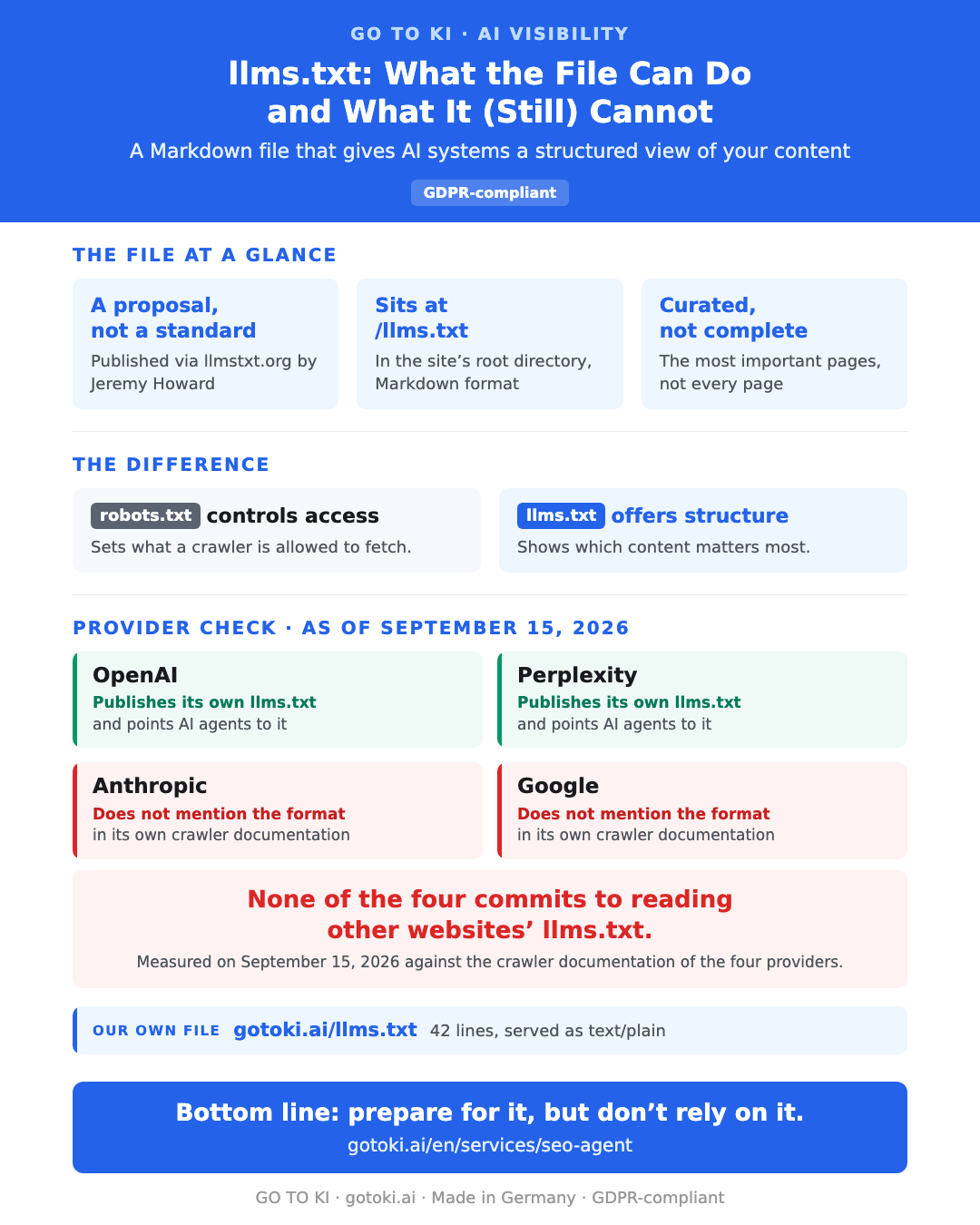
The provider check at a glance. Measured on September 15, 2026 against the crawler documentation of the four providers.
llms.txt in Practice: How to Proceed
If you decide to create an llms.txt, a structured approach is advisable. Start by taking stock of your most important subpages: which content is most relevant for your customers and for AI systems? Then prioritize that content instead of listing every single page – an overloaded file misses its purpose.
In the next step, you create the file in Markdown format and place it in the root directory at /llms.txt. Check the syntax carefully so that the structure can be interpreted correctly. Faulty formatting can mean that the file does not fulfill its purpose.
Ideally, creating an llms.txt should be part of a broader strategy for AI visibility in which AI agent technology also plays a role. How AI agents work shows how structured data is read out in practice and why a consistent, well-organized information architecture across different channels is gaining importance. Anyone who understands these connections makes better-founded decisions about how much effort should go into individual measures.
Conclusion & Call to Action
The llms.txt is an interesting but not yet widely established approach to AI visibility. As a stand-alone measure, you should not attach exaggerated expectations to it – it is useful above all as part of a well-considered GEO strategy that combines structured data, high-quality content and technical fundamentals. Anyone who understands these connections and addresses them deliberately gains a comprehensible advantage over a purely isolated implementation of individual measures.
Get individual advice and arrange a no-obligation SEO Agent consultation. Would you like to learn more about how we work? Get to know Gotoki as your AI partner.
Frequently Asked Questions
What is an llms.txt file and what is it used for?
The llms.txt is a Markdown file in the root directory of a website that is meant to provide a structured summary of the most important content for large language models. It typically contains a title, a description and links to relevant subpages, and is intended to help AI systems grasp content more quickly.
Is llms.txt already a recognized standard?
No, the llms.txt is so far a standardization proposal published via llmstxt.org by Jeremy Howard. A binding, universally supported standard that all AI providers are obliged to take into account does not currently exist.
How does llms.txt differ from robots.txt?
The robots.txt is an established mechanism for controlling crawling permissions for search engine bots. The llms.txt, by contrast, is not an access control instrument but a curated content overview intended to give AI systems orientation without governing access rights.
What is the difference between llms.txt and llms-full.txt?
The llms.txt usually contains a lean overview with links to important content. The llms-full.txt goes one step further and provides complete content directly in the file, which can make sense for extensive documentation but leads to considerably larger files.
Do ChatGPT, Claude and other AI systems actually use the llms.txt?
Use by large AI systems is currently not documented across the board. There is no uniform confirmation from the well-known providers that llms.txt is systematically read. The file should therefore be regarded as a supplementary, but not the sole, building block for AI visibility.